The Wright Family Massacre
The Tale of the Vampire BrideThe Wright family massacre is the violent destruction of Glynis Wright’s family as a unit and the beginning of her forced life under Vlad Dracula. It unfolds through a series of escalating captures: armed guards surround the carriage, supernatural blue fire destroys the attempted escape of the driver and Ovidiu, and Vlad takes Glynis while her parents and sister are brought into the castle. Her father’s resistance ends in his death; Glynis is left to hear her mother’s screams and to understand that the family’s flight has become a trap. The event’s significance reaches beyond the immediate attack: it begins the coercive transformation that makes Glynis Vlad’s bride and supplies the motive she later names when she strikes back at him.
The Ambush and Failed Escape
The family’s attempt to flee ends at the castle door. Dark-clad guards carrying torches pour out and encircle the carriage, hemming in the Wrights as they gather what they can carry. The torches throw moving shadows across the castle, but the danger is not only theatrical: the guards control the approaches and prevent the family from leaving. Against this display of force, the carriage offers only the appearance of safety. Glynis senses Vlad’s power drawing her attention toward him even before he reaches the family, establishing that the threat includes a supernatural hold as well as physical confinement.
The driver and Ovidiu make a break for a path away from the castle. They initially evade the guards, but Vlad stops his men from pursuing them and instead declares that his Brides will feast. Blue fire then follows the two fleeing men, surges over them, and vanishes; their screams cease, and no trace of them remains. Their failed escape demonstrates that the grounds are controlled not only by armed guards but by a force the family cannot resist or understand. For the Wrights, the scene removes the most immediate means of escape and turns the castle’s boundary into a killing ground.
The Family Is Separated
As the family cowers together, Glynis clings to her sister and mother while feeling the pull toward Vlad intensify. She knows that if he calls again, she may go to him despite her wish to remain with her family. The danger therefore divides her even before the guards physically separate them: she is frightened by Vlad and by the compulsion she experiences in his presence. Her father confronts him, but the protest does not alter the balance of power.
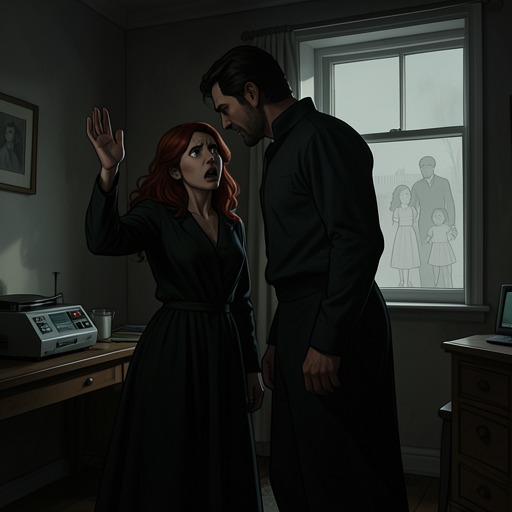
Two guards seize her father. The family tries to pull him back toward the carriage, and her mother, Antoinetta Wright, cries out in his defense. Vlad moves toward the carriage; Antoinetta places herself between him and the others. He then turns back into the castle, dragging Glynis with him and ordering that the others be brought. Glynis struggles, clutches at his wrist, and cries out in pain and anger as he pulls her away. Vlad’s declaration that all he possesses is hers does not offer a choice or a rescue: it follows the abduction and frames his control as a gift, while the surrounding violence makes clear that Glynis cannot refuse it safely.
The guards drag Glynis up the stairs while the rest of the family is led inside. She sees her mother holding May Wright, whose eyes are closed and whose body has collapsed; Antoinetta’s face is fierce despite the tears on it. Her father is still struggling with his captors. When he breaks free and charges Vlad, Vlad strikes him so quickly that Glynis hears the blow before she can make sense of it. Her father falls at Vlad’s feet, stunned. Vlad says he will die first for the attack. Glynis and Antoinetta scream as the guards pull Glynis farther up the staircase; Glynis’s last view of them is her mother falling to the floor with May slipping from her arms and her hands reaching toward Vlad in appeal.
Death, Captivity, and Forced Making
The separation becomes final when Glynis hears her father cry out and her mother scream. She falls to the ground, certain that Vlad has murdered her father, and the guards briefly release her arms. The pause offers no escape: she rocks with her face in her hands while the guards remain impassive and her mother’s cries continue through the castle. Vlad’s laughter rises from below as the guards lift Glynis and carry her on. The event thus reaches her not only through what she witnesses but through what she is forced to hear after she has been removed from her family.
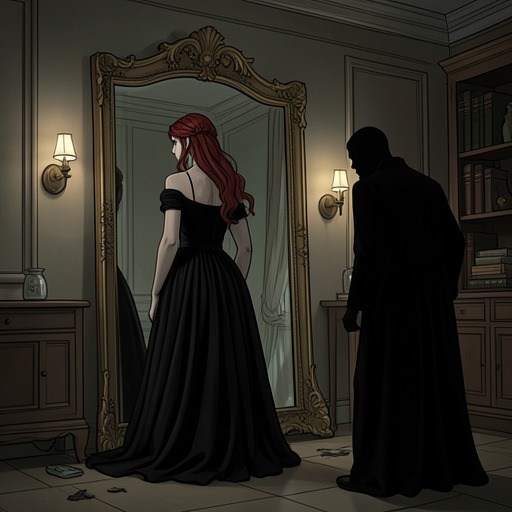
The subsequent scenes show what the capture was preparing. The Brides tell Glynis that, like every Bride, her time to be made by the Master has come. Vlad later orders her to undergo the vampire baptism once more and says she will join them. In the chapel where the vampires sleep during daylight, a coffin waits open at its center; Ariana and Elina withdraw into tombs, while Vlad and Cneajna remain with Glynis. The former holy space, now serving as shelter for vampires, makes her imposed entry into their world feel like an inversion of the religious life in which she was raised. These later moments distinguish the massacre from a single act of killing: it is also the first stage of Glynis’s confinement and transformation.
The Violence’s Long Afterlife
The family’s capture leaves its mark on Glynis’s later experience of vampirism. When hunger overwhelms her, Vlad presents blood in a goblet and commands her to drink because she is his bride. Cneajna holds her as Glynis sobs and resists the identity being imposed on her. The goblet and the command make explicit the connection between the family’s destruction and Vlad’s intended possession: survival inside the castle is conditioned on accepting the appetite and status he has forced upon her. Her transformation does not erase her attachment to the family; it becomes inseparable from the loss that precedes it.
That loss remains present years later. At an opera performance advertised as the life of Vlad Tepes, Glynis sits beside Vlad and her brother, Andrew Wright, while the Baroness explains the subject. Glynis looks toward Vlad, touches his hand, and recognizes that he will give her no answers. The scene places a public performance of Vlad’s life beside Glynis’s private knowledge of his violence, without suggesting that the opera itself explains the massacre. Later still, when Glynis drives a stake through Vlad and says it is for her family, the revenge directly names the people whose destruction began at the castle. The massacre is therefore both a rupture in the family’s story and the enduring measure by which Glynis understands her struggle against Vlad.